Overnight we morphed into a world working primarily from home and that has brought with it a host of additional pressures on our mental health, social and psychological wellbeing. One tool I have used for over thirty years is the simple and inexpensive tool of journaling. I started journaling as a teenager and I became a more consistent journal writer in my later twenties when I became a Mum.
Of course, I had no idea back in the mid-eighties when I was an undergraduate in university that over in Texas research scientist and psychologist Dr James Pennebaker, one of the most influential academics in the field of expressive writing was conducting research with students and senior executives into the impact of writing about trauma and emotional upheaval.
Writing Through the Tough Stuff
Pennebaker’s was one of the first longitudinal studies into writing and healing. In this first study college students and senior executives were invited to write for four to five consecutive days about a trauma or difficult life experience in as much detail as possible. Participants in the earlier and later studies wrote about getting divorced, losing a job, the death of a loved one, sexual abuse, depression all similar to issues we are all dealing with from the fallout from the triple pandemic.
Participants were instructed to write for 15-20 minutes and no longer. This alleviated the potential of ruminating on the experience.
Some participants reported feeling sad at first then feeling much better shortly afterwards. Many described the experience as transformative. When they followed up participants the results revealed a catalogue of physical and psychological benefits. These included: Fewer visits to the doctor’s surgery, students performed better in their studies, signs of a better improved immune system, better sleep, fewer colds, and less fatigue. Additional benefits included a boost in memory levels and evidence of lower depression symptoms and low moods in many of the participants in the trials.
Journal Through Furlough
From furlough to job losses to an escalating economic downturn the past research on the impact of expressive writing and securing employment provides some light at the end of the tunnel. Journaling is not for everyone but for many it is best positioned as a self-coaching method structured to help clients healthily release emotions and feelings that might be difficult to express to family and friends at the time.
Back in 1984 in economic conditions not dissimilar from the place we are in right now, another study headed up Pennebaker et al included working with a group of hardnosed engineers who had lost their jobs. Half of the group were assigned to write about their deepest thoughts and feelings about losing their jobs during the job search. The other half were asked to write about how they used their time. Both groups attended the same number of interviews. Eight months after writing the group of men who wrote about their emotions had new jobs compared to the 20 percent who wrote about how they spent their time. (Spera, Buhrfeind and Pennebaker 1994).
But expressive writing is not just a tool for expressing the difficult and challenging. There is real value in expressing your positive thoughts and experiences on paper too. Dr Laura King has explored the impact of writing about positive experiences. This has direct correlation to current conversations with coachees. Many have shared the guilt they feel about talking about the good stuff that is also happening in the midst of the pandemic. If we turn to the evidence base, King’s research highlights that when participants in the study journaled about the good things they experienced in their day and week this increased their levels of life satisfaction and fulfilment.
Our urbanised lives are becoming increasingly absent from ritual and ceremony. I have found in my own practice that the act of journaling during a quiet slice of the early morning is a meditative ritual and ceremony planted in days that are in danger of blurring one into the other as we are forced to work from home slaves to our laptops, iPads, and phone screens.
The debate on whether to write a journal by hand seems very much to be one of personal preference. Yes, research confirms we have better memory when writing by hand. But in the context of the pandemic this becomes even more compelling in that the very nature of a journal provides a metaphorical room of one’s own in homes that have overnight become both home and work due to restrictions of the lockdown. Your journal or notebook literally provides you with a mental and emotional room of your own to escape into.
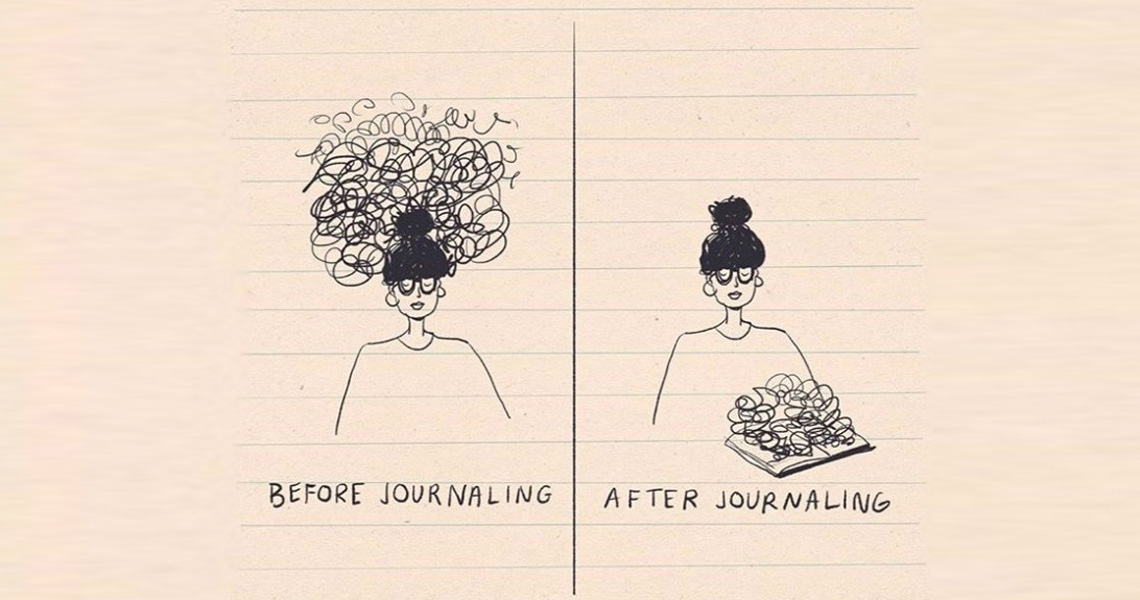
The more occupied hands are in the primal act of writing on paper or a more mindful tapping of fingertips on a keyboard the more freedom the mind has to both ask the right questions and connect to answers that are right for you. Knotted feelings and thoughts unravel, and scattered thoughts and ideas find connections.
It is not surprising when the world of neuroscience reminds us that when you give space by writing about the things that bother you, drain and deplete you, you free up space in the working memory of the mind. And in doing so you are better equipped to respond to more challenging and complex matters at hand.
Happiness Quota
There are a host of writing activities that can be engaged with in a journal or notebook. The practice of writing down the things you are grateful for has been shown to significantly increase levels of happiness. Research by Professor Theresa Glombe found that when women wrote down three positive things at the end of the working day and the reasons why they experienced it as positive, it improved their performance and indicated lower levels of stress compared to women who wrote about the routine things they performed in the day.
Personal Journaling
This last year what I have really appreciated about my journals is that it has also been a place of recording my joys. The little things in my day that make me smile or laugh or lift my spirits. The scene of the chubby chaffinches gobbling the heads of the dandelions in the front garden back in the spring. Or watching the gang of midnight blue crows from the desk in my office that descended on the chimney tops of the houses opposite me in May.
Don’t Sweat the Blank Page
Sharing journal prompts with clients gives clients not only a way of starting but a way of continuing. Recently a client shared over our zoom call the front pages of her journal where she had recorded several writing prompts we had discussed over the course of the coaching. She explained how when she felt stuck, didn’t feel like she knew what she wanted to say or was having a hard time starting the prompts would be the motivation that would get her downloading her thoughts and feelings onto the page.
This technique of applying shorter timed journal prompts alleviates anxieties about journaling and breaks the practice of journaling down into bite size chunks that is both manageable and doable. Often when clients realise that journaling can be easily carried out in shorter chunks, they naturally find themselves writing and enjoying the journaling over longer periods of time often barely noticing the minutes that have clocked up and flown by.
These journal prompts will help you expand the territory and scope of your journal writing as we embark on the start of a brand-new year.
Pandemic Journaling Prompts
- You’ll never have nothing to write about with this journal prompt. Every morning take a minute and look up at the sky. Set the timer for five minutes. Write about the colour and mood of the sky today? What shapes are the clouds? How does the sky reflect the colours or moods of your feelings or emotions right now/yesterday/this past week?
- When I think about Black Lives Matter I…
- When I think about COVID-19 I…
- When I think about the state of the economy in my part of the world, the UK as a country or the world I…
- I feel, I appreciate, I know, I realise…
- The thing I’m not writing or speaking about…
- Three good things that happened yesterday and why did they make me smile or feel good?
- The one thing I would most like to spend my time doing more of and why?
- What have been the uncomfortable themes of 2020? How did I address the discomfort and what more could I do in this area?
- What have I appreciated about 2020 and what have I learnt and valued?
- What activities or experiences do I know for sure brings me joy?
- How is it with me right now?
By Jackee Holder – Author, Leadership Coach and Coach Trainer
Jackee is the author of four non-fiction titles, 49 Ways to Write Yourself Well, Be Your Own Best Life Coach, Soul Purpose and a unique illustrated writing map, Writing with Fabulous Tree Writing Map: A Writing Map For Parks, Gardens and Other Green Spaces (2016) bringing together the restorative benefits of nature, eco-psychology, eco-geography and self-reflection through twelve tree inspired journal and creative writing prompts. She has published a collection of creative writing and journal writing e-books and creative resources which are available as free downloads on her website.
Jackee’s professional background is as a Leadership Coach and Coach Trainer. She works corporately, in the NHS with senior leaders and BAME nurses and midwives as well as the banking and financial services and voluntary sector organisations. This work is supported with a ground-breaking practice of facilitating creative writing workshops and online events for writers and creatives nationally and internationally.
Website: www.jackeeholder.com
Instagram: @jackeeholderinspires